A sub-4 Berlin Marathon: how Lena plans her race week.
Updated · 12 min read
Lena is 34, lives in Cologne and runs her first marathon at the end of September: Berlin. Flat, fast, and the Brandenburg Gate just before the finish. She's after a time starting with a three. The training is done and the fitness is there. What's missing is the plan for the last few weeks: pacing, carbs, gels, hotel, getting to the start, and two people who want to see her on the course.
This guide follows Lena from sign-up to the post-race recap. Each step covers what matters in the week before a marathon and how Lena plans it in Dolichos. The numbers fit her, and they scale to your body weight and goal time. Flying in from abroad? We've flagged the bits that matter for you.
Lena's race week at a glance
- Goal time
- sub-4:00
- Planned avg pace
- 5:40 /km (9:07 /mi)
- Carb loading, 2 days out
- 620–744 g carbs/day
- Race fueling
- 7 gels + sports drink
- Race-day alarm
- 6:30 am
- Crew
- Jonas on the course, Mira from home
Set up the race: paste a link, get the course
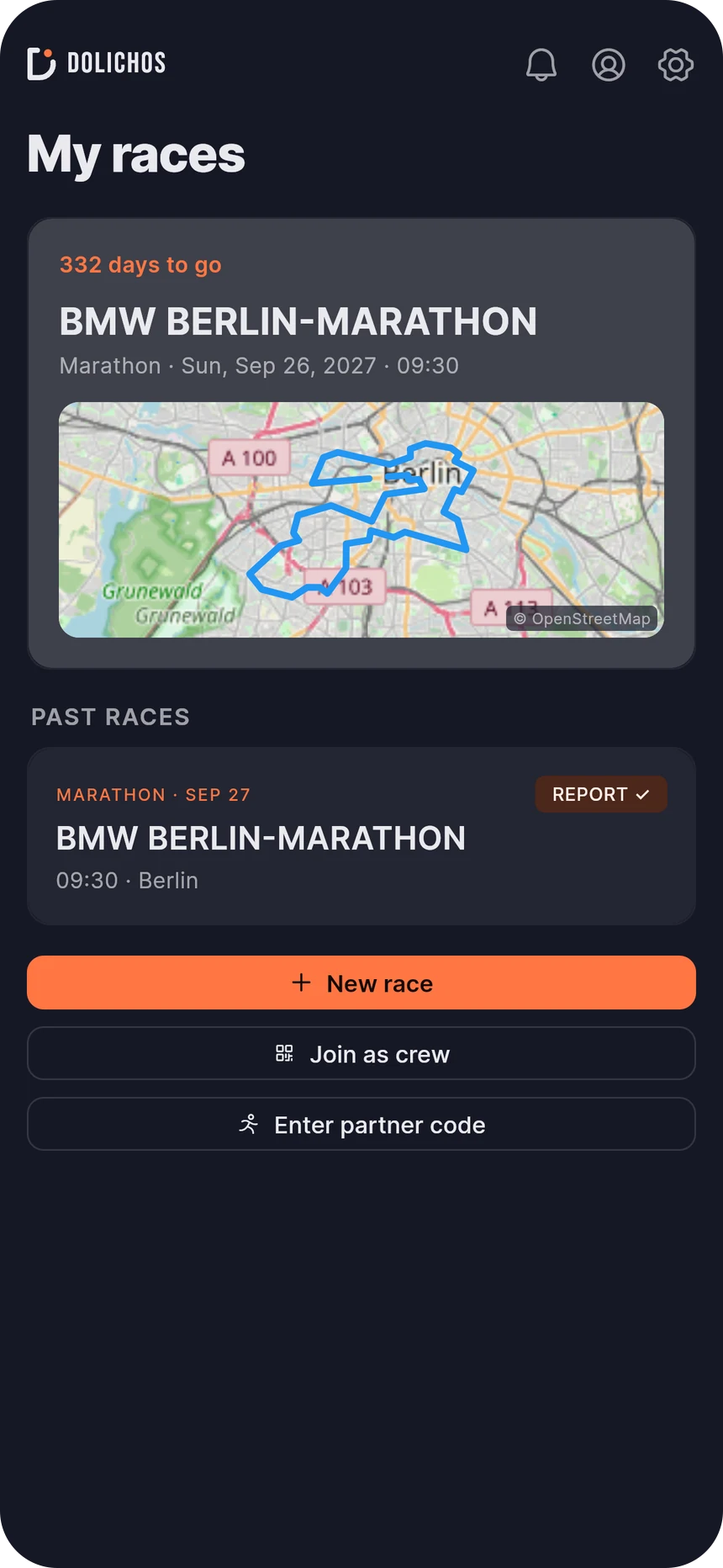
Lena doesn't start from scratch. She pastes the link to the Berlin Marathon organizer's website into Dolichos. The app reads the name, date, location and distance, and often finds the GPX file of the course too. Lena checks the details and saves, and the course appears on the map: from Straße des 17. Juni across the city and back via Leipziger Straße, Unter den Linden and through the Brandenburg Gate. The link stays with the race, so the organizer's schedule and notices are one tap away later.
In the same step she adds her hotel, just under half an hour's walk from the start, with check-in and check-out. Dolichos needs it later to work out when she has to leave on race morning.
Next up is her profile. Lena enters her weight, 62 kg, and her threshold heart rate of 168 bpm from a field test in the spring. That's all Dolichos needs to estimate heart-rate zones and fuel burn, and the app is upfront that these are estimates. If you've had a lab test, upload the PDF report or import the XML file from a Cortex metabolic cart. Dolichos then reads thresholds, VO2max, FatMax and fuel burn per stage, and zones and the energy curve use measured values instead of a rule of thumb.
- Import the race from the organizer link, GPX course included
- Step-by-step setup: distance, date, start time, hotel
- Profile from weight and threshold heart rate, lab test as PDF or Cortex XML optional
- Metric or imperial units, whichever you train in
- Prefer talking to typing? Connect Dolichos to an AI assistant and plan in conversation
The pace for a sub-4 marathon
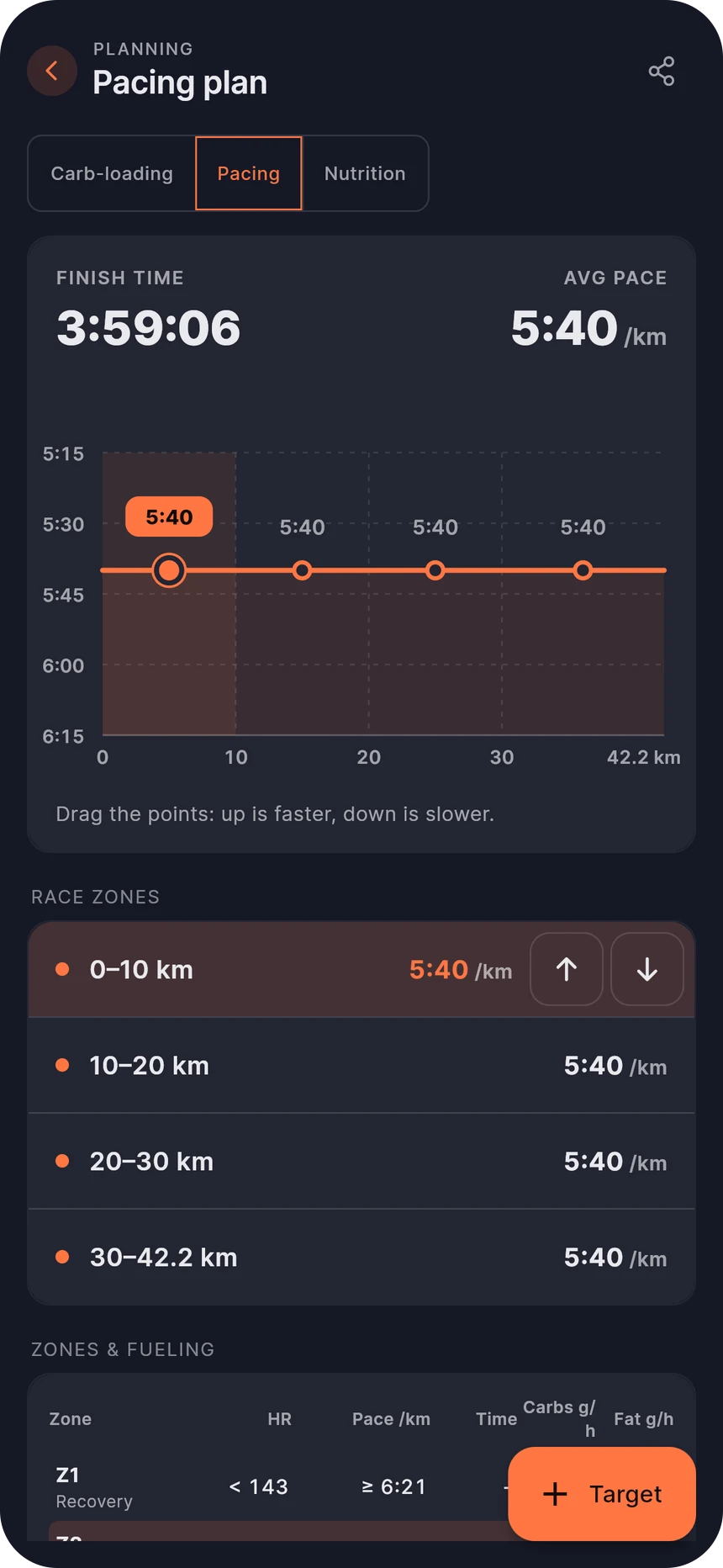
A 3:59:59 marathon needs an average of 5:41 per km, or 9:09 per mile. Lena plans for 5:40 to leave a little margin. Berlin is flat with barely any elevation, which makes it tempting to go out too fast. With the crowds in the first few kilometers, a calm start is the realistic option anyway.
The pace plan splits the course into four race zones. Lena tries a negative split on the chart, dragging the first section down and the last one up, and the finish time updates with every move. For her first marathon she settles on the simplest option: an even 5:40 per km in all four zones, finish time 3:59:06. The zone table below shows what that means: all 3 hours 59 in zone 2, at 143–150 bpm, burning around 95 g of carbs per hour. A comfortable effort she has run often enough in training.
- Pace per section by drag and drop, or in 1-second steps
- Finish time and average pace update live
- Heart-rate zone, time in zone and carbs/fat per hour for each section
- Kilometers or miles, depending on your settings
Gels, drinks and hitting the wall
At Lena's pace, four hours of running burns more carbs than her glycogen stores hold. The usual advice is at least 60 g of carbs per hour. Lena sets up her fuel in "My fueling", starting from the brand-free default catalog with typical values for a gel, a caffeinated gel, sports drink, electrolyte tablets and more. Then she enters the exact nutrition values of the gels she trains with.
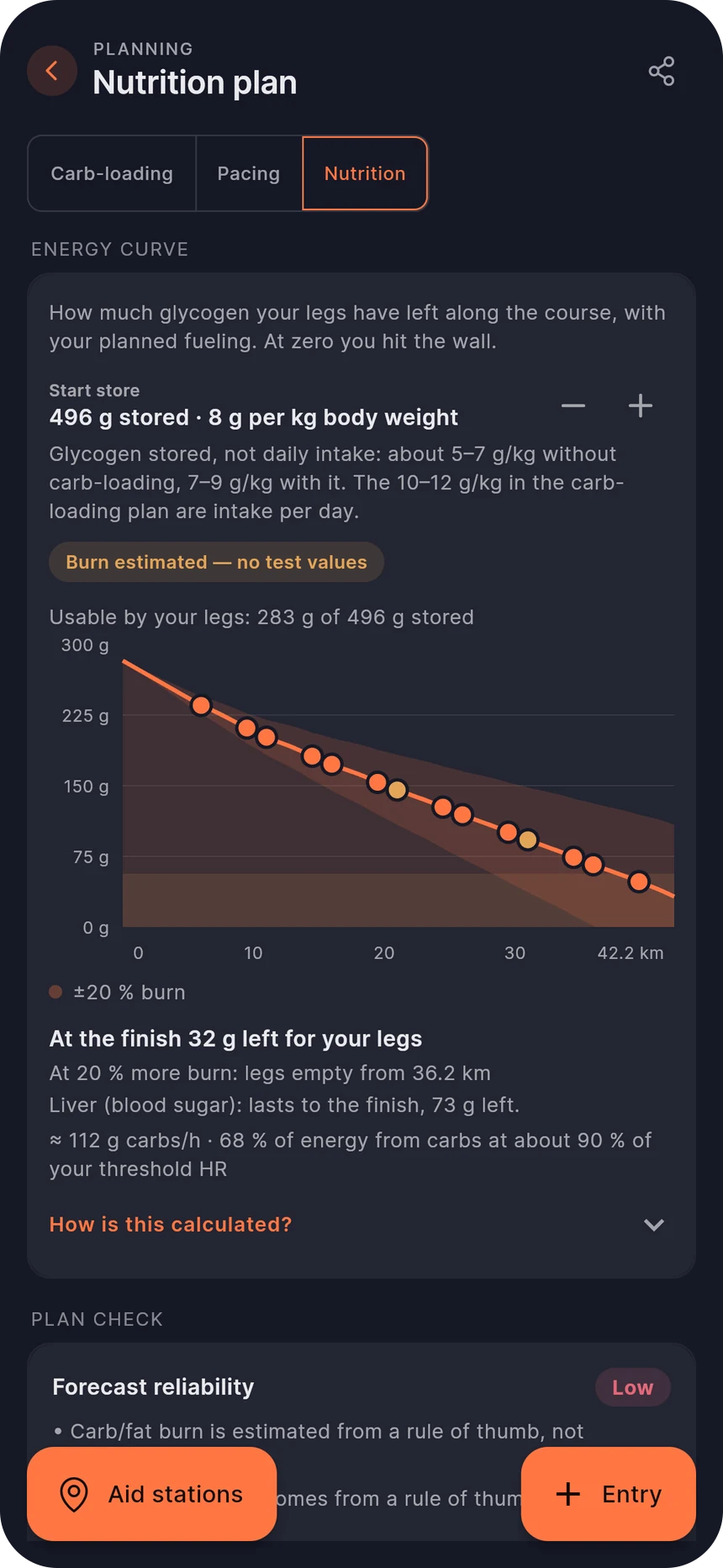
Her plan spreads seven 25 g gels across the course, from km 6 to km 36, two of them with caffeine. The energy curve shows how much glycogen her legs have left: of the 496 g in her stores, 8 g/kg after carb loading, 283 g are usable by her legs. The rest sits in her arms and trunk or keeps her blood sugar up via the liver. Over 42.2 km the curve falls, and 43 g are left at the finish. Tight, but enough. The light band around the curve shows how far the estimate can be off, and that's where it gets close: with 20 % more burn, Lena's legs would run empty from km 39.5, and she'd hit the wall before the finish.
The plan check warns about exactly that: "With 20 % more burn your legs would run empty at 39.5 km (the wall). Plan some buffer: more carbs or a slightly slower pace." On top of that: "Avg 44 g carbs/h – at least 60 g/h is recommended for this duration." Gels cover her blood sugar first, so they mostly spare the liver and leave less for the legs. So Lena adds a cup of sports drink at seven aid stations, about 15 g per cup. The stations sit on the course with their km mark and planned arrival time. That brings her to 70 g of carbs per hour, 92 g are left for her legs at the finish, and even with 20 % more burn it still lasts. The forecast's confidence is "Low", and the plan check says why: her fuel burn is estimated from a rule of thumb, not measured. A lab test would make the forecast more precise.
- Energy curve of what the legs have left, with an uncertainty band and every gel and drink as a marker
- Plan check: average carbs per hour, peaks, gaps, caffeine, confidence
- Aid stations on the course with planned arrival times
- Schedule intake by distance or by time
The crew: Jonas on the course, Mira on the couch
Jonas, Lena's partner, is coming to Berlin. Mira, her running coach, follows the race from home. Lena drops the invite link into the group chat and gives Mira the six-character code. When he joins, Jonas sets a four-digit PIN. If his phone loses the session on race day, he signs back in with it and keeps his assignments.
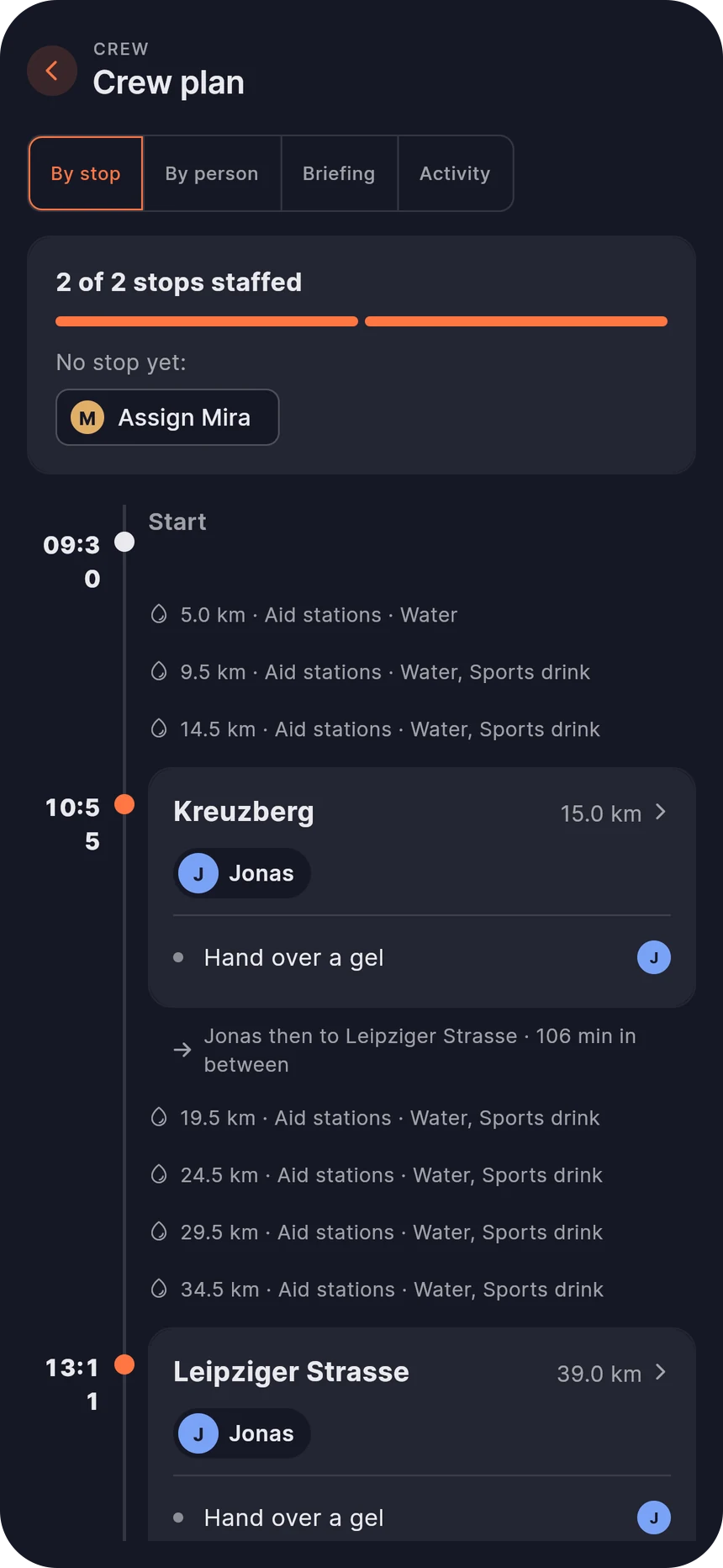
Lena makes Jonas a spotter and Mira a coach. Then she puts two stops on the course: Kreuzberg at km 15, around Kottbusser Tor, where the bands and drum groups play, and Leipziger Straße at km 39, just past Potsdamer Platz. The crew plan shows both on a timeline from start to finish, with Lena's expected arrival from her pace plan: 10:55 am in Kreuzberg and 1:11 pm on Leipziger Straße. The aid stations in between are listed too.
With "Who stands here?", Lena puts Jonas at both stops. The sheet shows for each person whether a stop fits, is tight or overlaps with another one. Between the stops it now says "Jonas then on to Leipziger Straße · 106 min in between", plenty of time for the U-Bahn, even with a buffer at both ends. At both stops, Lena adds the task "hand over a gel", which only someone standing there can take on. The top of the plan reads "2 of 2 stops staffed". Mira is listed as "no stop yet", and that's on purpose: she'll be at home on race day.
- Join by code, link or QR code
- Roles: general, spotter, coach
- Crew plan as a timeline: stops with expected arrival, people and tasks
- "Who stands here?" with a hint: fits, tight or overlapping
- The handoff between one person's stops at a glance
- Tasks per stop, ticked off by the crew on race day
- Sign back in with a PIN, revoke invites any time
Monday to Friday: taper, expo, carb loading
On the Monday before the race, the race week view shows every day through Sunday. The marathon template has already spread out the usual items: a rest day, a last short session with a few kilometers at race pace, an easy shakeout on Saturday, packing the bag. Lena moves the rest day to Thursday, her travel day.
In Berlin you pick up your bib in person at the marathon expo. Lena adds the expo as a place and sets Friday as pickup day. Dolichos works out how long it takes from her hotel on foot, by bike, by car or by public transport. The readiness check at the top keeps count: "7 of 9". Still open are the crew briefing and the packing list.
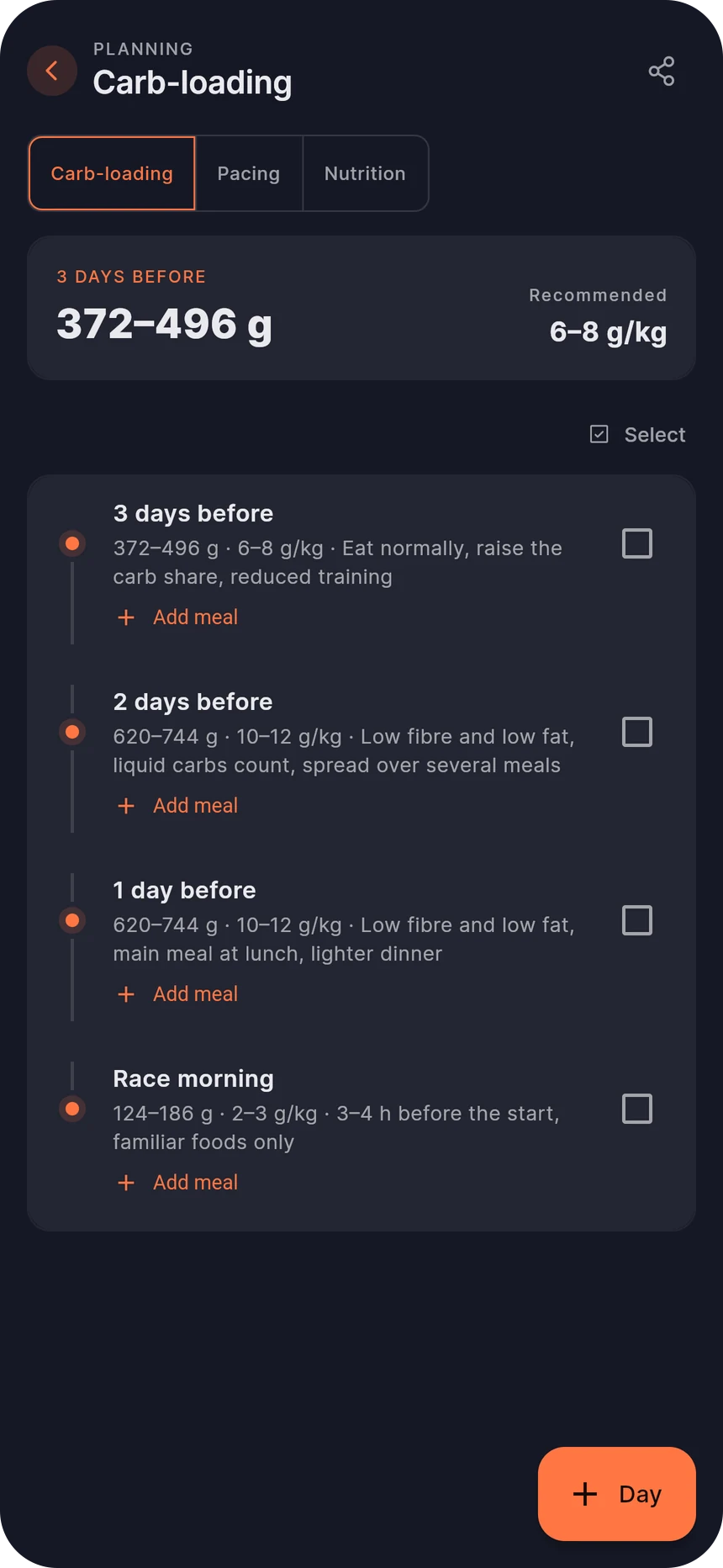
Carb loading starts on Thursday. For Lena's 62 kg, Dolichos works out 372–496 g of carbs three days out (6–8 g/kg), then 620–744 g on each of the two days before the race (10–12 g/kg). After every meal she taps +25, +50 or +100 g. A ring shows her progress, and in the evening "180 g to go" tells her she still needs a glass of juice and a bread roll.
- Countdown and daily cards from Monday to race day
- Readiness check: the gaps still open in your plan
- Bib pickup day with the route from your hotel
- Carb-loading target in grams, logged with a tap
The day before: an alarm worked out backwards
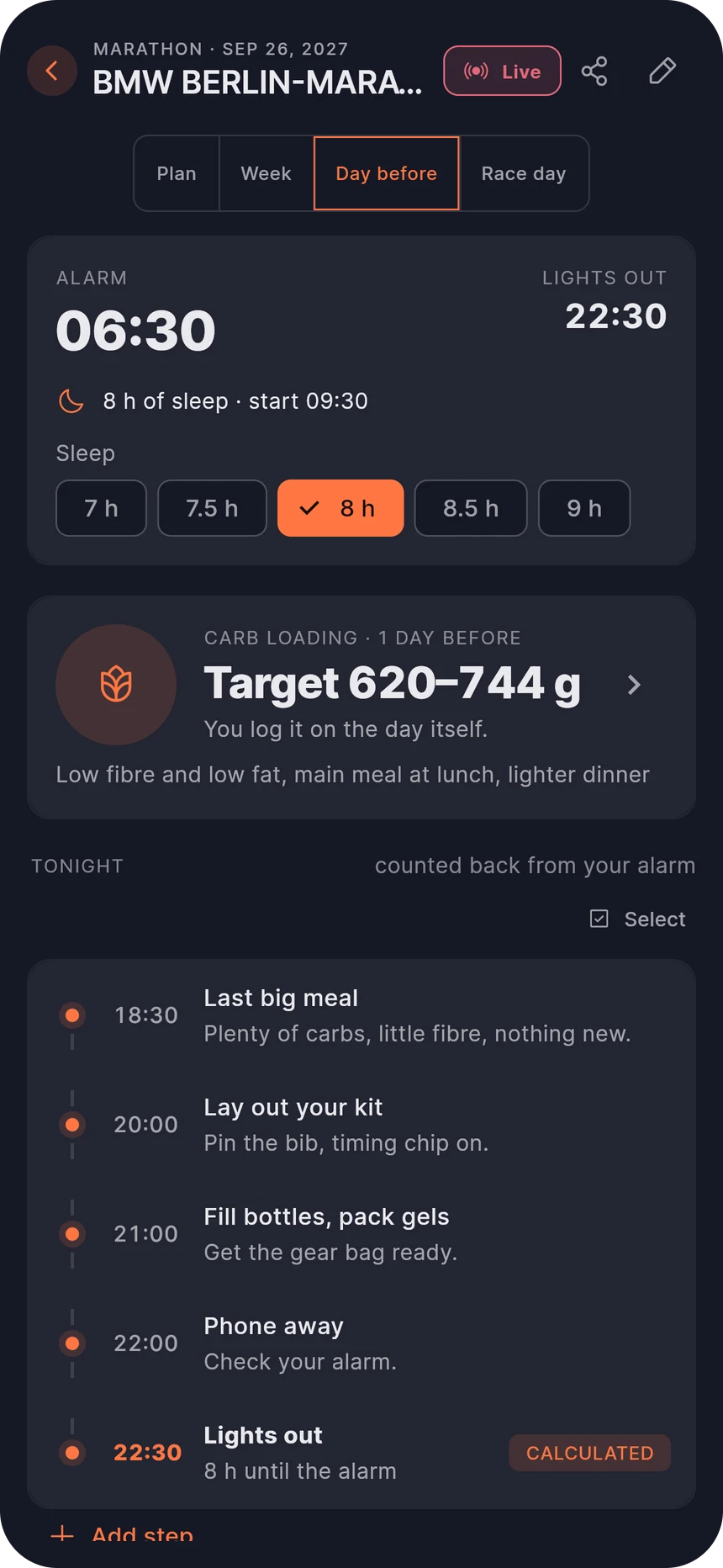
In our example, Lena's start wave goes at 9:30 am. Breakfast needs three hours before the gun, so her alarm goes off at 6:30 am. She picks eight hours of sleep, and Dolichos sets lights out at 10:30 pm.
The evening plan counts back from there: last big meal at 6:30 pm, kit laid out with bib and timing chip attached at 8:00, bottles filled and gels packed at 9:00, phone away at 10:00. Above it sits the day's carb-loading target: 620–744 g. The packing list comes from the distance and her fueling plan: bib and pins, timing chip, shoes, watch, finish-line bag, seven gels. She shares the crew briefing as text in the group chat, so everyone knows who stands where, when, and what to do.
- Pick 7 to 9 hours of sleep, and the alarm and lights-out are set
- Evening plan with times, every step editable
- Packing list including the gel count from your fueling plan
- Crew briefing to share
Race day: leave at 8:04, start at 9:30
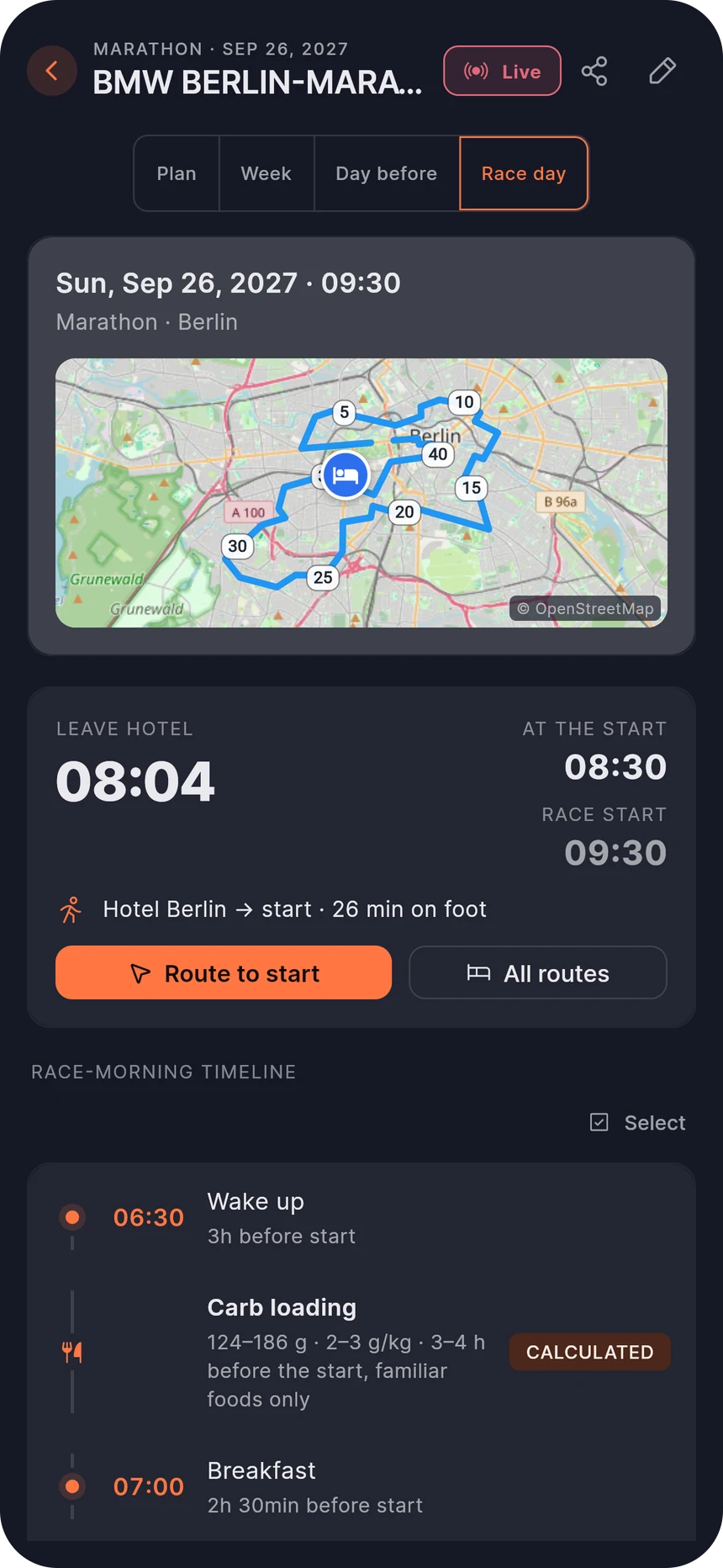
On race morning, one screen has it all: leave the hotel at 8:04 am, arrive in the start area at 8:30, an hour before the 9:30 start. It's a 26-minute walk. "Route to start" opens her phone's navigation, with the organizer link right above it. The readiness check reads "Your plan is complete", 9 of 9. Every time shows in Berlin time, which matters if you've flown in from another time zone and your phone is still confused. The race-day view is stored on the device, so it opens even when the mobile network around the start is overloaded.
Lena runs without her phone, and live tracking doesn't need it. From the gun, Dolichos works out her position from the pace plan. Jonas gets a notification when the race starts and another as Lena approaches Kottbusser Tor. He sees her and taps "Athlete spotted". She's 40 seconds ahead of plan, and every later arrival time moves up. At home, Mira watches on the map where Lena is.
On Leipziger Straße, Jonas waits with the next gel, and the map tells him Lena is three minutes out. If the network drops, the app stores his sighting and sends it later. A few kilometers on, Lena runs through the Brandenburg Gate, and Jonas and Mira get the "Finished" notification.
- Departure, arrival and start time in the race's time zone
- Race-day view works offline
- Live position without a GPS tracker, corrected by every sighting
- Notifications: race started, athlete approaching, window missed, finished
- Optional GPS from the athlete’s phone, ETAs use the real pace
Recap: plan versus reality
That evening, Lena sits in a restaurant with her medal and opens the recap: her finish time, planned versus actual arrival at every spot, and who saw her where. The first 10 km were right on plan, and the second half was a little faster. For her next marathon, she knows where there's still time to find.
Dolichos works the same way for 10K, half marathon and ultra, and for triathlon from sprint to full distance, with pace per discipline, transitions and a shuttle bus to the start.
More on Crew & live trackingBerlin Marathon race week checklist
Lena's plan to take away. The timing works for any marathon; scale the grams to your own body weight.
| When | What | In Dolichos |
|---|---|---|
| 8 weeks out | Import the race from its link, add your hotel, fill in weight and threshold HR | Race week planner |
| 6 weeks out | Build the pace plan with race zones, check the finish time | Pacing plan |
| 4 weeks out | Test your fueling in training, get the plan check to green | Fueling plan |
| 3 weeks out | Invite your crew, staff your stops, hand out tasks | Crew & live tracking |
| Monday | Adjust the race-week template, set your rest day | Race week planner |
| Thursday | Start carb loading: 6–8 g/kg | Carb loading calculator |
| Friday | Pick up your bib at the expo, 10–12 g/kg carbs | Carb loading calculator |
| Saturday | Shakeout, packing list, crew briefing, lights out on time | Race week planner |
| Sunday | Breakfast at 2–3 g/kg, leave on time, crew reports sightings | Crew & live tracking |