Your pace plan for marathon, half marathon and triathlon.
Even pacing over 26.2 miles is the theory. In practice you start a little easier and deal with hills, wind and aid stations. With Dolichos you plan the pace section by section, see your finish time instantly and know what it costs you in energy.
Get started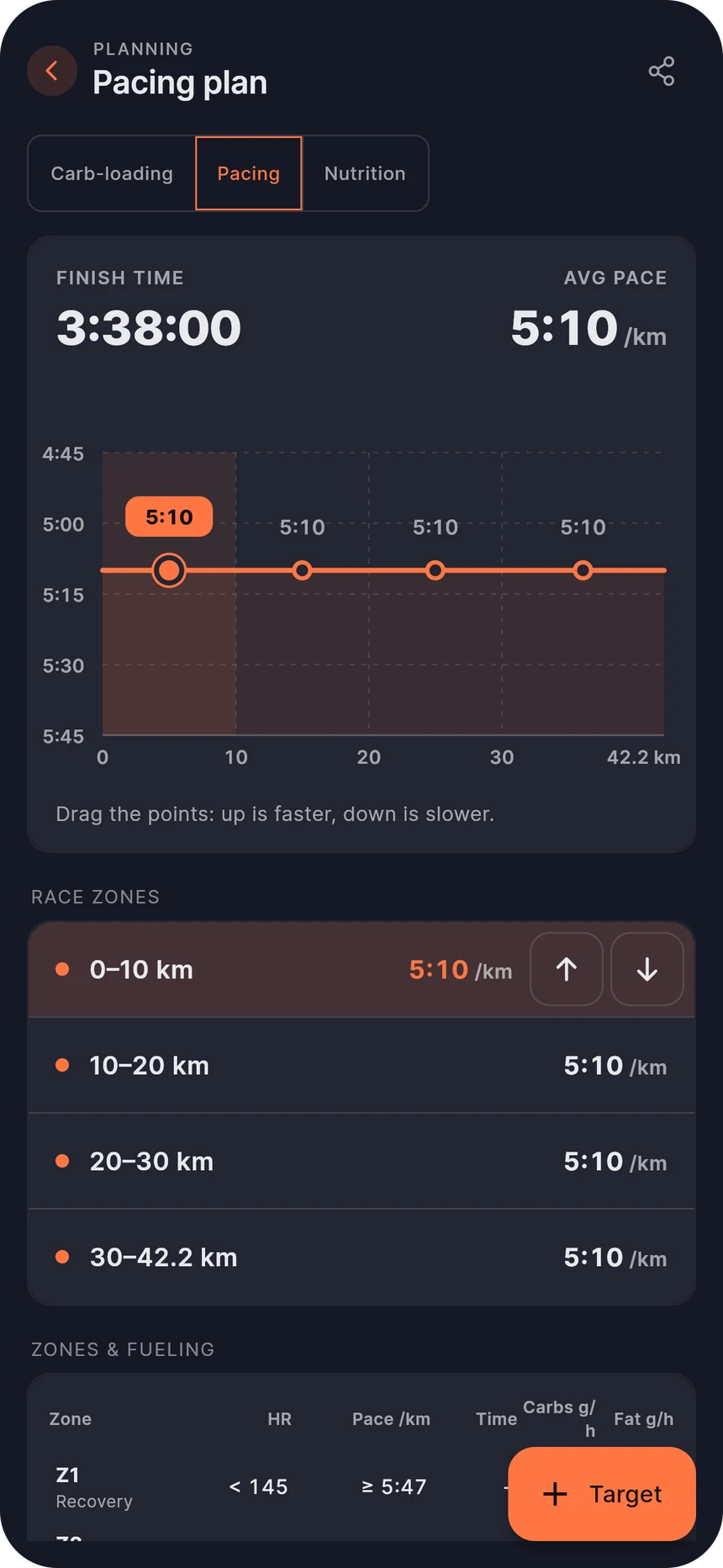
Drag your pace on the chart
The course is split into race zones, for example 0–10, 10–20, 20–30 and 30–42.2 km. Drag a point up and that section gets faster, down and it gets slower. Goal time and average pace update instantly. Prefer buttons? Nudge the pace one second at a time.
- Negative split, even pace or a cautious start: all visible
- Goal time and average pace update live
- Templates for marathon and 70.3, adjustable for any distance
Heart rate and carbs per zone
Below the chart, the zone table shows how long you run in each heart-rate zone and how many carbs and how much fat you burn per hour. It is based on your profile with weight and threshold heart rate or, if you have them, the values from your lab test.
- Training zones with heart-rate and pace ranges
- Time in zone for the whole race
- Carbs g/h and fat g/h as the basis for your fueling plan
- Estimates are clearly marked as estimates
Measured values instead of rules of thumb
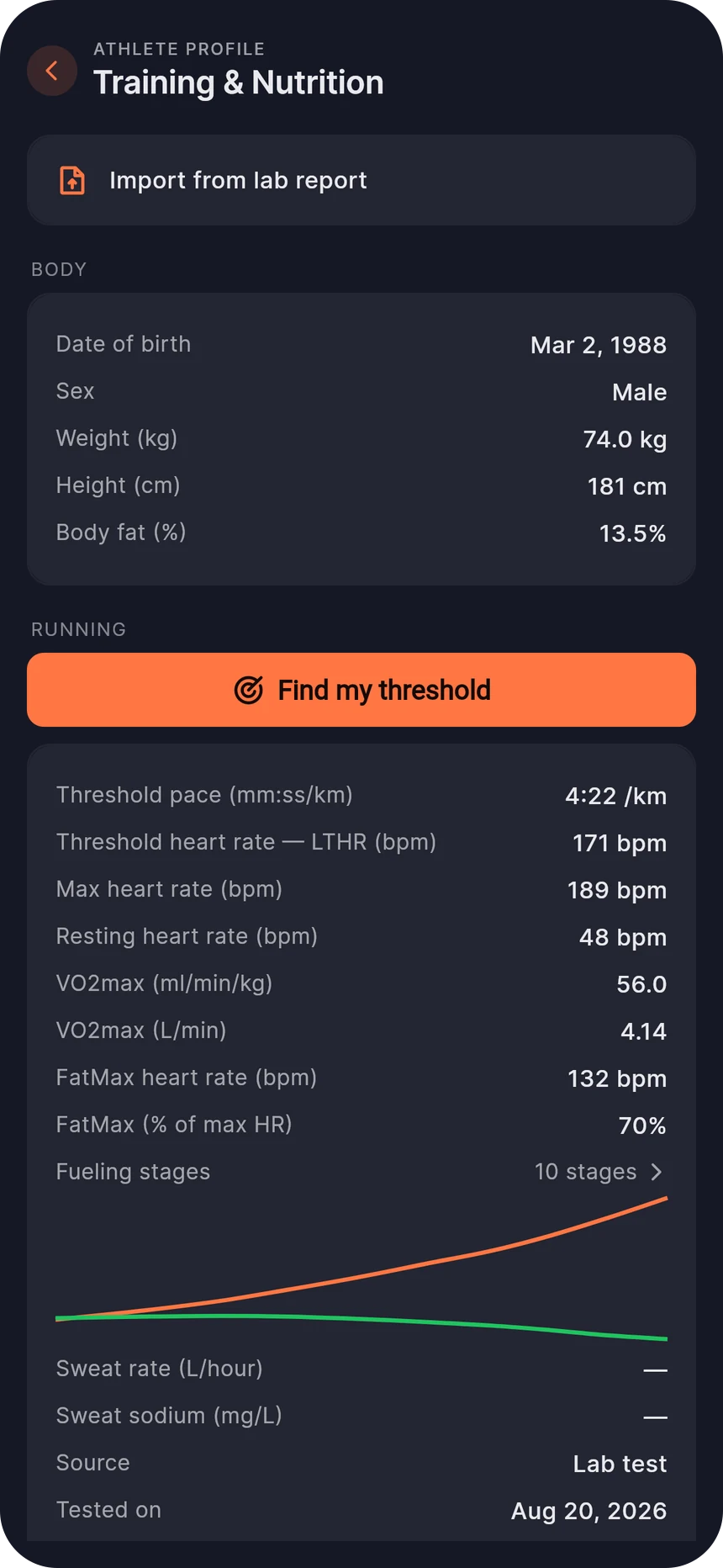
Had a performance lab test or a metabolic (CPET) test? Upload the PDF report or import the XML file from the Cortex device. Dolichos extracts the values and shows them for review before saving, including the detected sport. From then on, zones and fuel burn are based on your test.
- Body data, threshold pace, threshold HR, max HR and resting HR
- VO2max, FatMax and carb/fat burn per stage
- Separate for running and cycling
- Adjust any value by hand at any time
Every discipline in its own unit
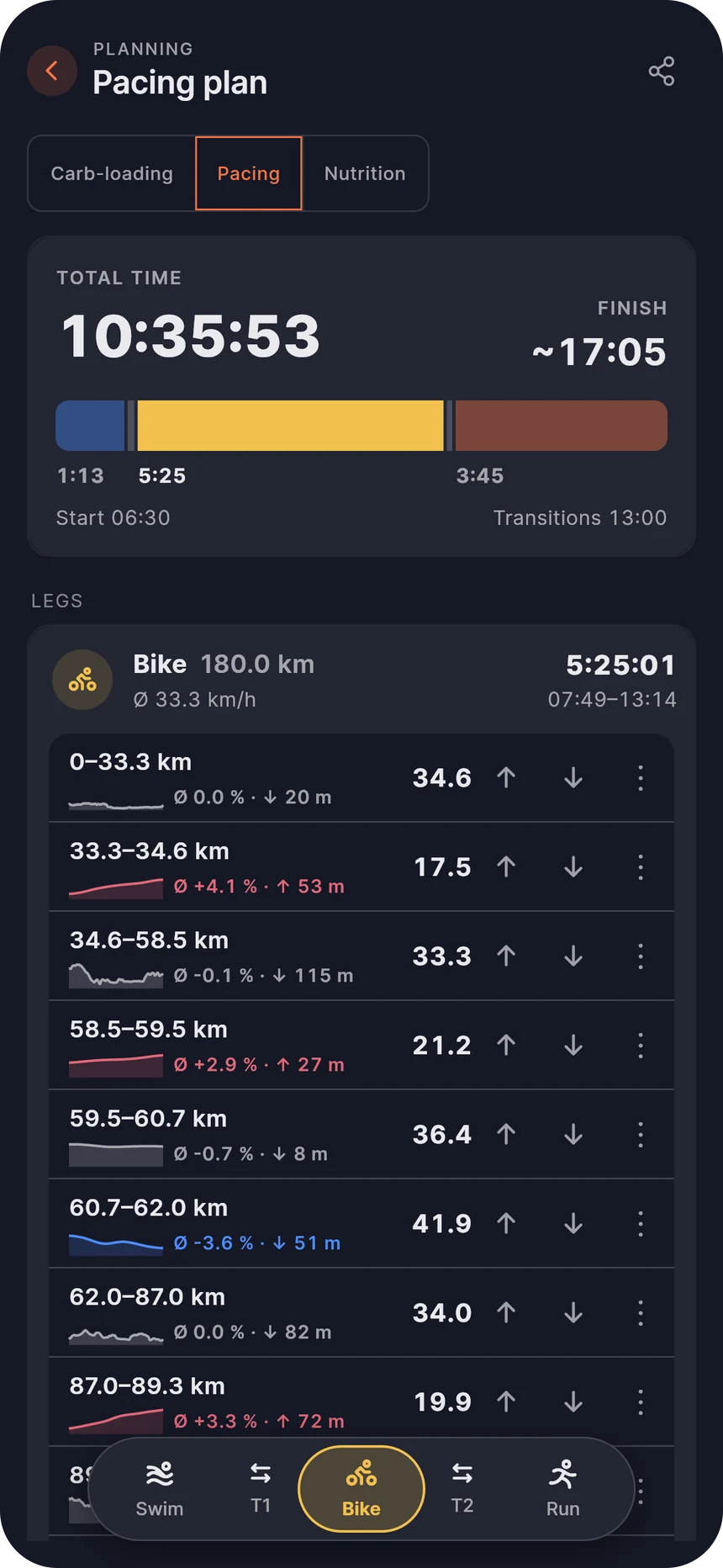
For triathlon you plan the swim in min/100 m, the bike in km/h and the run in min/km. The switcher at the bottom moves between swim, T1, bike, T2 and run, and a dot shows where a pace is still missing. Each discipline has its own pace sections, and a small elevation line under each one tells you whether it is flat, uphill or downhill.
- Swim, T1, bike, T2, run planned separately
- Finish time and arrival from all five parts
- Transitions with a planned duration and their own checklist
- One GPX file per discipline
Pace the bike by power, not by feel
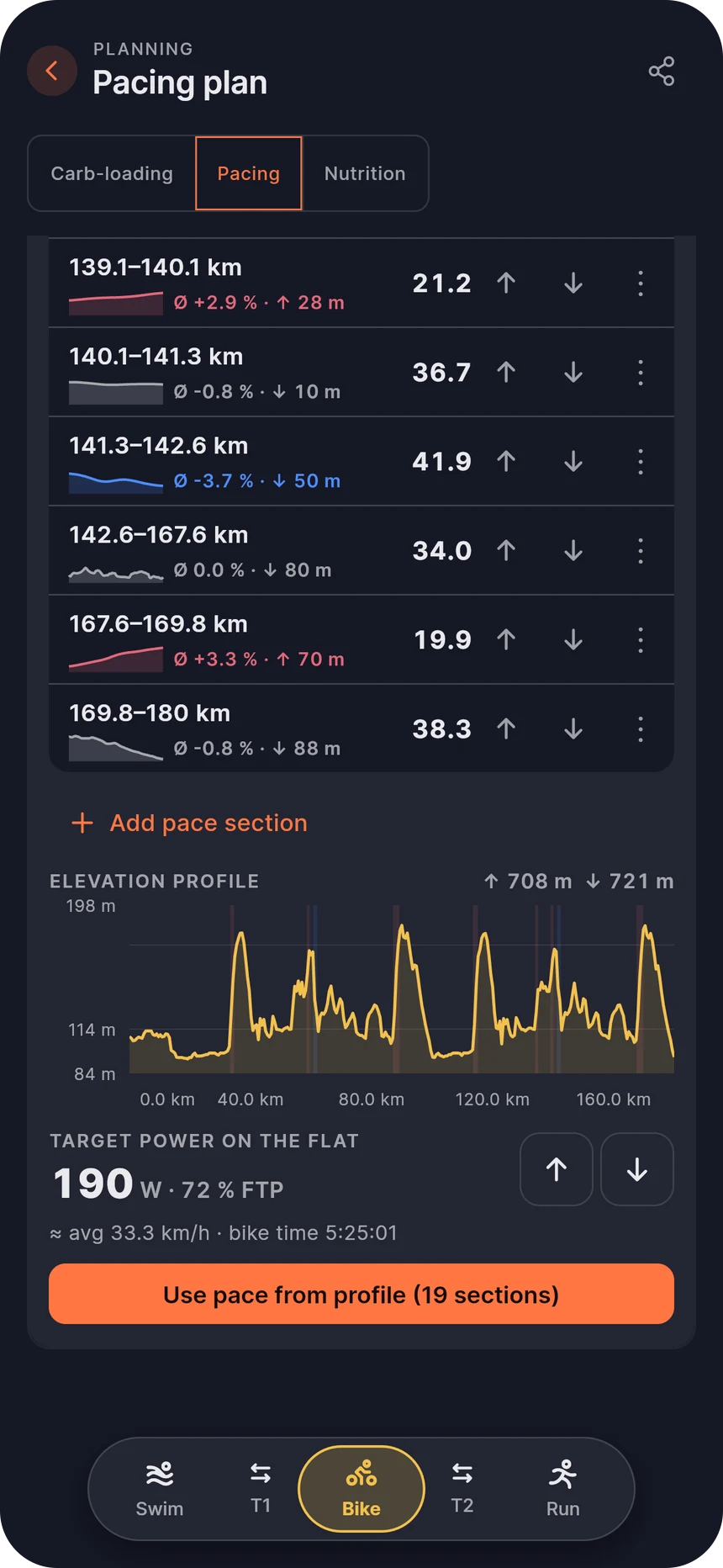
Everyone slows down on a climb and speeds up on the way down. Enter your target power for the flat, and Dolichos also shows it as a share of your FTP. The app splits the bike course into climbs, flat stretches and descents from the elevation profile and works out the right speed for each: a few more watts uphill, fewer downhill. One tap turns them into your pace sections, and your finish time, energy curve and live forecast follow.
- Elevation profile with climbing from your GPX file; missing elevation is looked up
- Target power in watts and % FTP, with the bike time right away
- Preview every section before you apply it
- Elevation profile for the run course too
Your pace plan becomes a live forecast
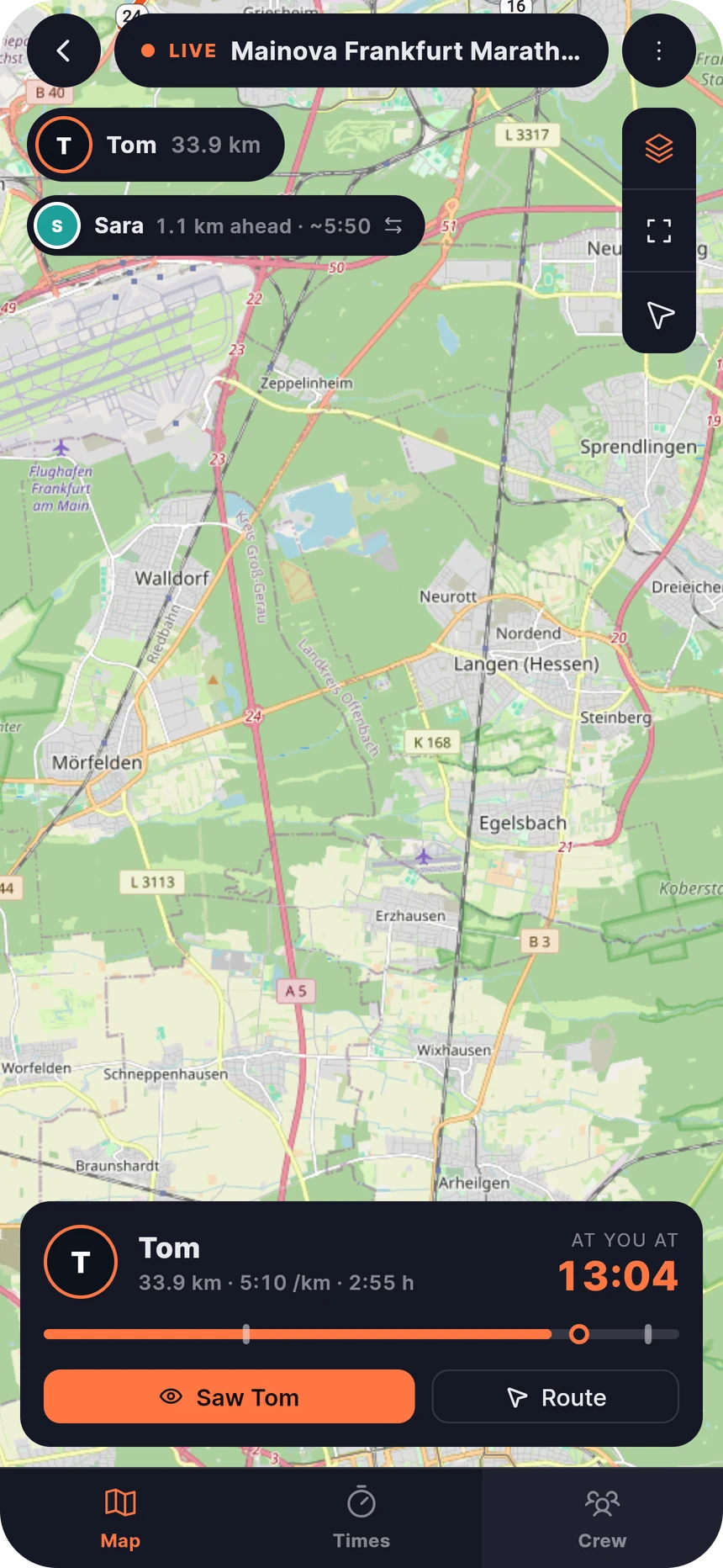
On race day Dolichos uses your pace plan to work out where you are and when you will reach every crew spot. When someone from your crew sees you, the forecast is corrected with your real pace.
- ETA for every point on the course
- Corrected by every sighting
Frequently asked questions
What pace do I need for a sub-3:30 marathon?
For 3:29:59 you need an average of 4:58 per km, about 8:00 per mile. In Dolichos you enter the goal time and spread the pace across the course, for example with a slightly easier start and a faster second half.
Guide: a sub-4 Berlin MarathonShould I run a marathon at an even pace?
For most runners an even or slightly negative split is the safest strategy. How you distribute your pace is up to you; Dolichos shows what it means for your finish time and energy use.
How does Dolichos know my heart-rate zones?
From your profile: weight and threshold heart rate are enough for an estimate. A lab test, imported as a PDF report or Cortex XML, makes it more accurate.
Can I plan a half marathon or a 10K?
Yes. Dolichos supports 5K, 10K, half marathon, marathon and ultra as well as every triathlon distance.
Does the pace plan account for hills?
Yes. Dolichos reads the elevation from your GPX file and looks it up when it is missing. On the bike you enter a target power, and the app works out the right speed for every climb and descent. On the run you see the elevation profile, and each pace section shows how much climbing it holds.
How does the pace plan turn into an arrival time for my crew?
Every point on the course has a distance. Your planned pace gives the time you reach it, and on race day that time is recalculated with every sighting.
More features
Race week planner
Race week, the night before and race day: countdown, alarm, evening plan, packing list and hotel departure.
Open pageCarb loading calculator
Carbs in grams per day, calculated from your weight. Log with a tap.
Open pageFueling plan
An energy curve across the course, a plan check for carbs per hour and your own gels.
Open pageCrew & live tracking
Invite your crew with a code, hand out assignments and get live ETAs, with optional GPS from your phone.
Open pageSpectator link
Family and friends follow your race live from a link, with no way to change anything.
Open pageRunning partners
Two runners, one crew: link your races and everyone sees you both live on one map.
Open pageRace report
After the race: GPS splits, your pace curve, notes from your crew and a reflection that comes back when you plan the next one.
Open pageAI assistant
Plan race week with Claude or ChatGPT: pacing, fueling, race morning and carb loading by chat.
Open page
Ready for your race week?
Create an account and plan your next race, right in your browser on iPhone, Android or desktop.
Get started